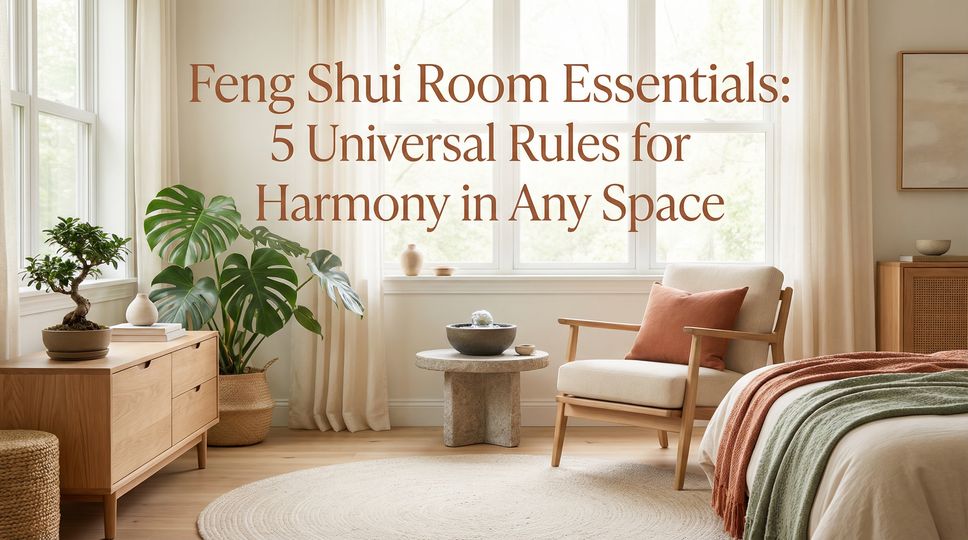
Whether you are renovating a home office, refreshing a bedroom, or organizing a living area, the goal remains the same: creating a space that feels good, flows well, and supports your life goals. While every specific area of the house has its own nuances in Traditional Chinese Geomancy, there are foundational principles that apply to every single feng shui room.
In this guide—the first in our comprehensive series on home harmony—we are going back to basics. We will explore the universal rules that turn a stagnant space into a sanctuary of positive Chi (energy). Before you worry about lucky bamboo or Bagua maps, master these five essential pillars.
1. The Command Position: Taking Control of Your Space
The single most important concept when designing a feng shui room is the Command Position. This principle relates to how you position the key furniture in the room—usually the bed in a bedroom, the desk in an office, or the main sofa in a living room.
What is the Command Position?
To be in the command position, your furniture must be placed so that:
- You can clearly see the door (entrance) to the room.
- You are not directly in line with the door.
Why It Matters
When you have your back to the door, your nervous system remains on low-level alert because you cannot see who or what is approaching. This creates subconscious anxiety and drains your energy. When you are directly in line with the door (the "coffin position"), the energy rushing in can be too aggressive and disruptive.
Pro Tip: If your room layout makes the command position impossible (common in small apartments), place a mirror on the wall or desk so you can see the reflection of the door from where you sit or sleep. This "cures" the layout issue.
2. Clearing the Path: Circulation and Chi Flow
Imagine water flowing through a creek. If there are too many rocks and fallen branches, the water becomes stagnant or rushes turbulently around obstacles. Energy (Chi) moves through a feng shui room in the exact same way.
To ensure a room has good feng shui, you must physically walk the path of the energy.
- The Entrance Test: Can you open the door a full 90 degrees? If there are coats, shoe racks, or boxes behind the door preventing it from opening fully, you are literally blocking opportunities from entering your life.
- The Pathway: Walk from the door to the window or the main seating area. Do you have to turn sideways, step over a rug that curls up, or dodge the corner of a coffee table? These physical obstacles create mental blockages.
Ensure there is a clear, meandering path through the room. The energy should be able to move freely without getting trapped in cluttered corners.
3. Lighting: Balancing Yin and Yang
Lighting is one of the fastest ways to shift the energy of a feng shui room. It represents the Fire element and is directly connected to clarity and visibility in your life.
Avoid the "Shadow Corners"
Dark, neglected corners represent stagnant areas of your life. If a corner of your room is perpetually dark, the energy there creates a vacuum.
- The Fix: Place a floor lamp or a table lamp in the darkest corner of the room to activate the energy.
The Kelvins Matter
- Yang Rooms (Office, Kitchen, Living Room): These are active spaces. Use brighter, cooler light (3000K-4000K) to stimulate focus and conversation.
- Yin Rooms (Bedroom, Bathroom): These are restorative spaces. Use softer, warmer light (2700K) to signal the body to relax.
Expert Advice: Avoid fluorescent lighting whenever possible. It flickers at a rate imperceptible to the eye but stressful to the brain. Full-spectrum LED bulbs are a much better choice for a high-vibe feng shui room.
4. Biophilic Energy: Connecting to Nature
Synthetics, plastics, and sharp metal edges can make a room feel sterile and lifeless. To breathe life into a feng shui room, you must introduce living energy. This is often categorized under the Wood element, representing growth, vitality, and new beginnings.
How to Introduce Nature
- Live Plants: Plants are the ultimate Chi enhancers. For beginners, a Snake Plant or Pothos is forgiving and excellent for air purification. (Note: Avoid spiky plants like cacti in bedrooms, as their "sharps" can create prickly energy).
- Natural Materials: Incorporate wood furniture, cotton rugs, wool throws, or bamboo shades. These materials have a grounding effect that plastics cannot replicate.
- Fresh Air: It sounds simple, but stagnant air equals stagnant energy. Open your windows for at least 10 minutes a day to let the old Chi out and fresh Chi in.
5. The "Less is More" Principle (Decluttering)
You cannot feng shui a room effectively if it is filled with clutter. In feng shui philosophy, clutter is not just "stuff"—it is delayed decisions and an inability to let go of the past.
- Under the Furniture: Do not store things under your bed or sofa. You want air and energy to circulate under you to support you. Sleeping on top of old tax documents or emotional mementos disrupts your rest.
- The Broken Window Theory: Repair or discard anything that is broken. A stopped clock, a chipped mug, or a burnt-out lightbulb all send a signal of neglect to the subconscious mind.
A Simple Exercise
Stand in the center of your room and look around. Does your eye get "stuck" on piles of paper or disorganized shelves? If your eye gets stuck, the energy gets stuck. Clear the surfaces to clear your mind.
Conclusion: Start with One Room
Creating a feng shui room doesn't require an expensive interior designer or a complete renovation. It starts with intention. By placing your furniture in the command position, ensuring the energy flows freely, balancing your lighting, adding nature, and removing clutter, you create a container that supports your well-being.
Don't try to do the whole house at once. Pick one room today—perhaps the one you spend the most time in—and apply these five universal rules. You will likely feel the shift in atmosphere almost immediately.
Stay tuned for the next post in this series, where we will dive deep into the specific requirements of the most critical room in the house: The Bedroom.