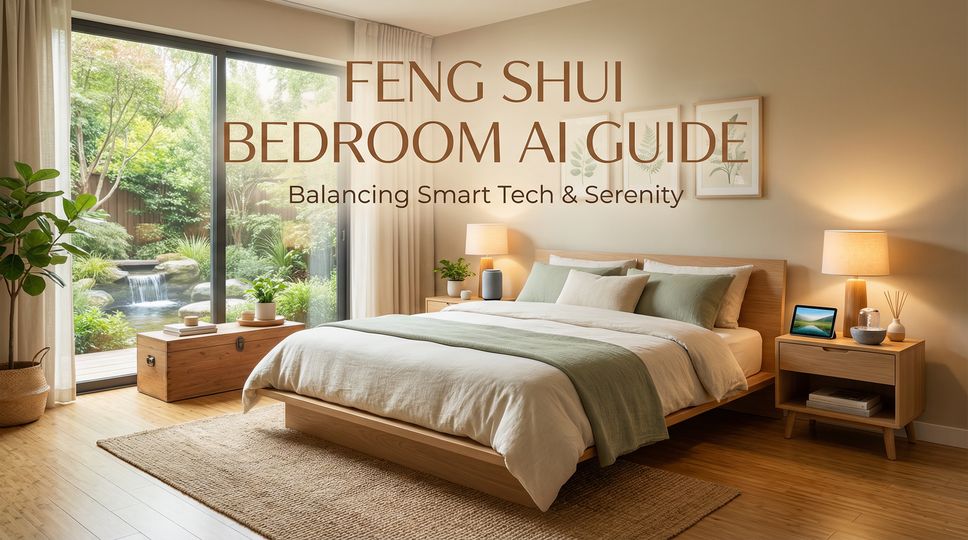
Feng Shui Bedroom AI Guide: Balancing Smart Tech & Serenity
In the modern age, our sanctuaries are becoming increasingly intelligent. From voice-activated lighting to sleep-tracking sensors, Artificial Intelligence (AI) has found its way into our most private space: the bedroom. But for the Feng Shui practitioner, this presents a unique paradox.
Feng Shui is an ancient art dedicated to the flow of energy (Chi) and harmony with nature. AI and smart technology, conversely, represent the pinnacle of modern stimulation, electricity, and connectivity.
Can the two coexist?
In this guide, we explore the concept of Feng Shui Bedroom AI—not just how to use AI tools to design your room, but how to manage the presence of Artificial Intelligence and smart tech within your sleeping quarters to ensure your restful Yin energy remains undisturbed.
The Clash: Ancient Chi vs. Modern Algorithms
To understand how to harmonize these elements, we must first understand the conflict.
The Bedroom Goal: In Feng Shui, the bedroom is a Yin space. It should be passive, quiet, dark, and restorative. It is the one room in the house where energy should settle.
The Nature of AI & Tech: Smart devices represent Yang energy. They are active, often emit light (blue light), generate electromagnetic fields (EMFs), and connect to the outside world.
When you invite AI into your bedroom—whether it’s a smart speaker listening for commands or a hub blinking in the corner—you are introducing active, alert energy into a space designed for rest. However, this doesn't mean you have to live like a luddite to have good Feng Shui. You simply need intentional boundaries.
5 Strategies to Harmonize Smart Tech with Bedroom Feng Shui
If you love your smart home conveniences but value your sleep quality, here is how to blend these two worlds effectively.
1. The "Invisible" Tech Rule
Visual clutter creates mental clutter. In Feng Shui, seeing a stack of wires, blinking routers, or camera lenses can trigger subconscious alertness, often referred to as the "fight or flight" response.
- The Fix: If you use AI devices, they should be heard and not seen. Hide smart hubs behind books or in ventilated cabinets.
- The Tape Trick: Use "dimming dots" or simple black electrical tape to cover any standby LED lights on your devices. Total darkness is essential for Yin energy.
2. Smart Lighting: Using Tech to Mimic Nature
Interestingly, this is one area where Feng Shui bedroom AI integration is actually beneficial. Traditional Feng Shui emphasizes living in rhythm with the sun.
Smart lighting systems (like Philips Hue or LIFX) can be programmed to support your circadian rhythm:
- Morning: Program lights to fade in slowly with cool, white light (imitating sunrise) to wake you gently with Yang energy.
- Evening: Automate lights to shift to warm, amber/red tones and dim automatically two hours before bed. This reduces blue light exposure and signals the body to produce melatonin, aligning perfectly with Feng Shui principles of winding down.
3. The Electronic Boundary Zone
Your bed is the command position of your life. It requires protection. A common mistake is placing AI assistants (like Alexa or Google Home) directly on the nightstand near the head.
- EMF Exposure: Even on standby, these devices emit low-level Electromagnetic Fields. Feng Shui advises keeping electrical currents away from the head to prevent sleep disturbances.
- The "Listening" Anxiety: Subconsciously, knowing a device is "active" and listening can prevent deep psychological relaxation.
- The Solution: Move smart speakers to the opposite side of the room, at least 6 to 8 feet away from the bed. You can still give voice commands, but your aura remains clear of the electronic field.
4. Sleep Trackers and Wearables
AI-driven sleep trackers are popular, but they introduce a "monitoring" energy into the bed.
If you must track your sleep:
- Prioritize Wearables over Bed Sensors: A ring or watch is preferable to a sensor mat placed under the mattress. The mattress should be a neutral, grounded foundation.
- Airplane Mode is Mandatory: If your tracker syncs via Bluetooth, ensure the device is in airplane mode while you sleep. Sync the data in the morning. This severs the digital cord to the outside world during your rest period.
5. Digital Mirrors
Some modern bedrooms include smart mirrors or TVs with AI capabilities. In Feng Shui, mirrors facing the bed are a major taboo (they are said to bounce energy around, causing restlessness or inviting third parties into the relationship).
A "smart" screen that is black and reflective acts as a dark mirror.
- Cover it up: If you have a TV or smart display facing the bed, cover it with a beautiful textile at night.
Using AI Tools to Create Your Feng Shui Layout
If you are looking at the keyword "Feng Shui bedroom AI" because you want to use software to help you design the room, we are living in a golden age for this.
Instead of guessing where to put your bed, you can utilize AI-powered interior design apps. Here is how to prompt them for the best results:
- Take a Photo: Upload a photo of your empty room to an AI interior design tool.
- The Prompt: Be specific. Do not just say "design a bedroom."
- Try this prompt: "Redesign this room using Feng Shui principles. Place the bed in the command position facing the door but not directly in line with it. Use soft earth tones and ensure symmetry with nightstands. Remove all visible electronics."
- Analyze: Use the AI visualization to see if the flow looks open and unblocked before moving heavy furniture.
The Verdict: Mindful Integration
The goal of Feng Shui is not to reject the future, but to ensure the future supports our human needs.
Feng Shui bedroom AI is about being the master of your technology, rather than the servant. By using smart lighting to support natural rhythms, distancing EMFs from your sleeping body, and using AI design tools to optimize your layout, you can create a space that is modern, smart, and deeply serene.
Remember: The smartest room is one that allows you to recharge fully, so you can tackle the world tomorrow.