In the world of Feng Shui, the ideal home is often described as a perfect square or rectangle. This shape represents stability, balance, and an even distribution of Qi (energy). However, let's face it: modern architecture rarely adheres to simple geometry.
If you have been following our series on the Bagua map for home, you likely know how to overlay the energy grid on a standard floor plan. But what happens if your home is L-shaped, U-shaped, or has a jagged footprint? Do you lose out on specific life aspirations like Wealth or Relationships?
Fear not. An irregular floor plan is not a sentence to bad luck. In this guide, we will dive deep into how to apply the Bagua map to complex layouts and how to energeticially "cure" missing areas.
The Concept of the Missing Corner
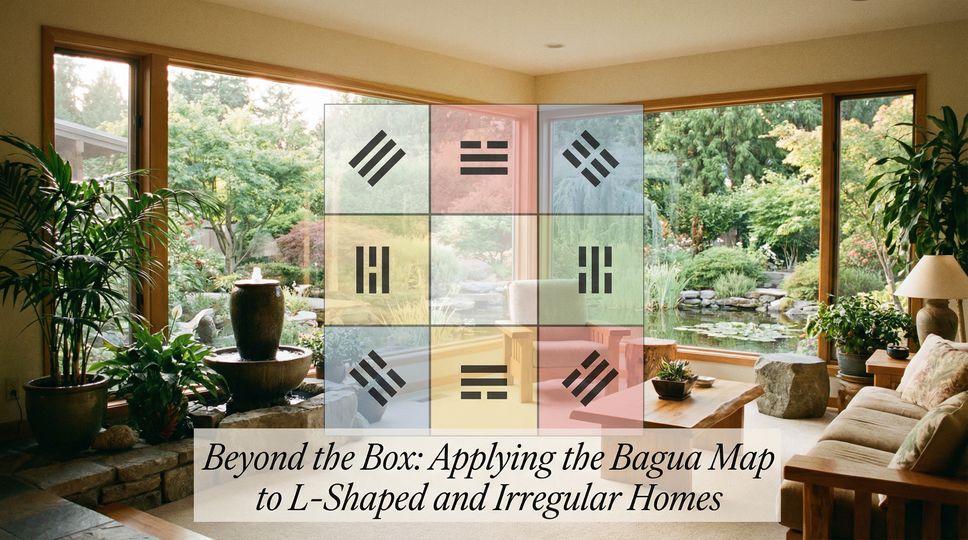
When you overlay the nine-square Bagua grid over an irregular floor plan, you will inevitably find that some sections of the grid land outside your walls. In Feng Shui, these are called Missing Corners or Negative Spaces.
A missing corner implies that the energy in that specific area of your life may be weaker, unsupported, or harder to access. For example:
- Missing Southeast: May lead to difficulties accumulating savings or financial instability.
- Missing Southwest: Could manifest as struggles in finding a partner or maintaining harmony in marriage.
- Missing North: Might result in a lack of career direction or feeling "stuck."
Extension vs. Missing Corner
Before you panic, you must determine if an area is truly "missing" or if you actually have an "extension."
The 50% Rule: Look at the wall where the irregularity occurs.
- If the protruding part is less than 50% of the width of the building, it is considered an extension (which is actually good luck!).
- If the indented part is less than 50%, the empty space is considered a missing corner.
How to Map an Irregular Home
To accurately place the Bagua on an odd-shaped house, follow these steps:
- Draw the Footprint: Sketch your home's exterior walls on a piece of paper. Include garages if they are attached and used frequently.
- Square it Off: Draw a dotted line to complete the shape into a perfect square or rectangle. Imagine you are filling in the negative space.
- Align the Bagua: Align the bottom of this "virtual square" with your front door wall (using the Three Door Method) or align it to magnetic North (using the Compass Method).
- Identify the Gaps: The areas inside the dotted line but outside your actual walls are your missing sectors.
Feng Shui Cures for Missing Corners
Once you have identified which Gua (sector) is missing, you can use Feng Shui cures to energeticially complete the shape of the home. You don't need to build a new room; you simply need to tell the Qi that the space exists.
Here are the most effective ways to cure missing corners:
1. The Mirror Cure (Internal)
If the missing corner creates an interior wall, you can dissolve that wall visually using a mirror.
- The Strategy: Place a large mirror on the wall that borders the missing sector.
- The Effect: The reflection creates depth, symbolically pulling the missing area into the home.
- Tip: Ensure the mirror is clean and does not reflect clutter, bills, or the toilet.
2. Lighting and Landscape (External)
If you have access to the garden or yard where the missing corner would physically be located, you can anchor the energy from the outside.
- The Strategy: Place a tall light post, a flag pole, a large statue, or a heavy rock at the corner where the "virtual" walls would meet to complete the square.
- The Effect: This acts as an energetic anchor, squaring off the property and reclaiming the space.
3. Elemental Enhancements (The Room Adjacent)
If you cannot alter the outside or hang mirrors, you can strengthen the sector by enhancing the room that borders the missing area using the Five Elements.
If you are missing the Wealth Corner (Southeast):
- Element: Wood.
- Cure: In the room closest to this missing corner, add vibrant plants, the color green, or a water feature (Water feeds Wood). This pumps extra Qi into the area to compensate for the structural lack.
If you are missing the Relationship Corner (Southwest):
- Element: Earth.
- Cure: Use heavy ceramics, square shapes, crystals (especially Rose Quartz), and earthy tones like ochre, terracotta, or yellow in the adjacent room.
If you are missing the Career Corner (North):
- Element: Water.
- Cure: Add mirrors, black or dark blue decor, or moving water images in the sector closest to the North.
Handling the L-Shaped House
The L-shaped house is the most common irregular shape. In Feng Shui, this is sometimes referred to as a "Cleaver" shape, where the blade creates a cutting energy.
Specific tips for L-shapes:
- Soften the corner: The interior corner of the "L" often points inward like an arrow. Soften this protruding corner with a trailing plant or hang a crystal sphere in front of it to disperse the sharp Qi.
- Close the loop: Mentally and visually try to complete the rectangle using the external cures mentioned above (lights or landscaping).
Conclusion: Intention Over Perfection
It is important to remember that having a missing corner does not mean you are doomed to fail in that area of life. It simply means that area requires more conscious attention and intention.
By identifying the missing piece of your bagua map for home and applying these cures, you are acknowledging the imbalance and taking active steps to correct it. In Feng Shui, intention is 50% of the work. As you place your mirror or plant your garden light, visualize the energy of your home becoming whole, stable, and supportive.